Carrier verification 13.08.2026
Carrier Verification with AI: Fast, Convenient and… Is It Really Safe?
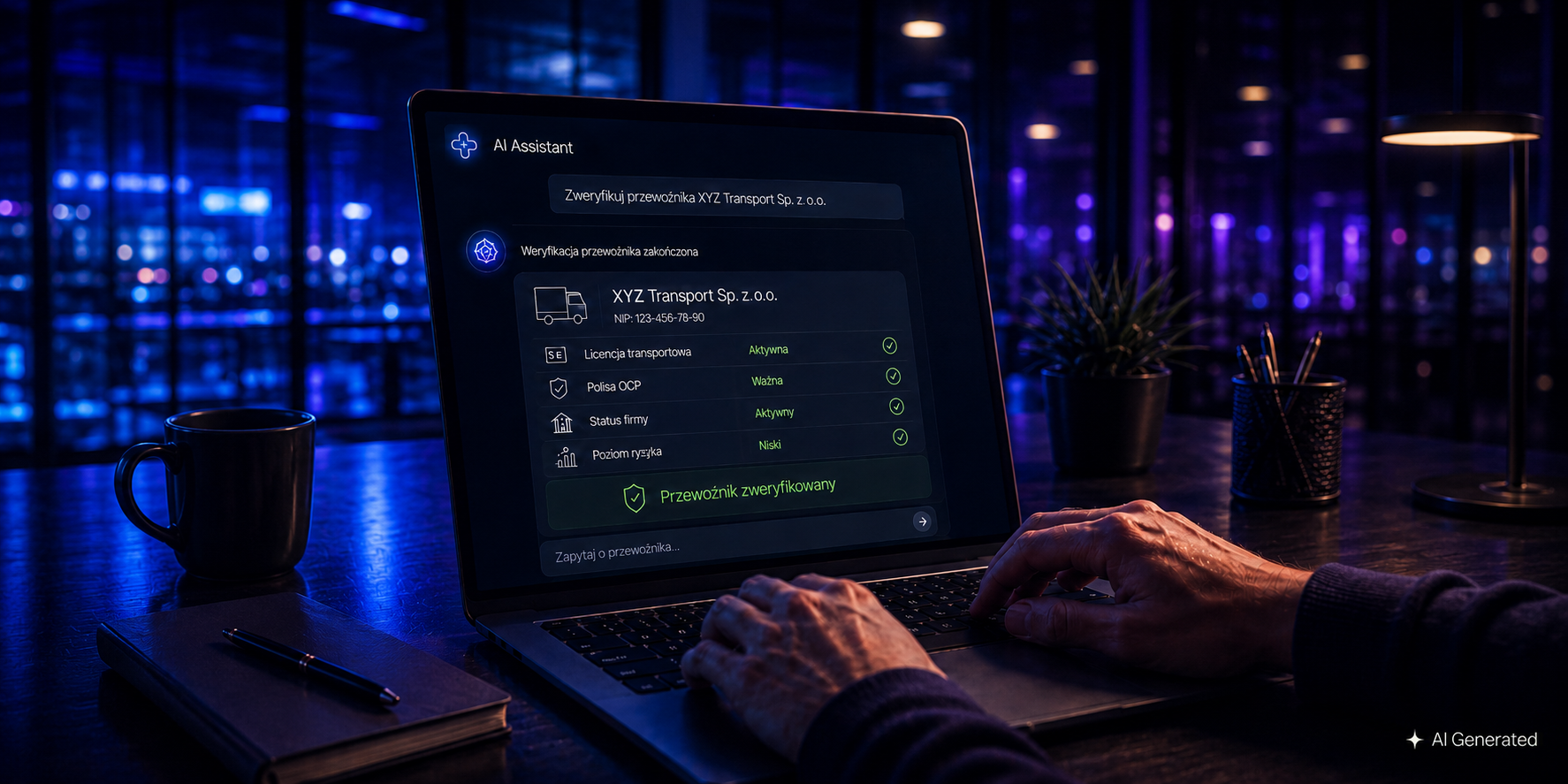

Artificial intelligence is becoming an increasingly common part of freight forwarders’ day-to-day work. And it’s easy to understand why.
AI can analyse a carrier’s liability insurance policy in seconds, summarise a contract, extract the most important information from a document, identify potential inconsistencies, or prepare a list of points that require further verification.
The problem begins when we start treating a support tool as a verification tool. In the carrier verification process, there are in fact two completely different types of risk:
The first concerns the information we provide to AI.
The second – information we receive from AI.
A carrier’s liability insurance policy, a contract with a counterparty, or other documents used in the verification process may contain personal data and confidential information.
These documents may contain, among other things, the personal information of company representatives, contact details, signatures, or information arising from the business relationship between the parties. If such a document is sent to an external AI service, the data it contains is processed as part of that service’s operations. And this is where one of the most common misunderstandings regarding the use of artificial intelligence arises:
“My data is not used to train the model” doesn’t mean “my data is not processed.”
In order for the AI system to analyze a document and generate a response, the information provided must be processed. However, factors that may vary depending on the provider, service version, configuration, and applicable agreements include, among others, the purpose and scope of processing, data retention, security policies, and the possibility of using the content to improve models.
For example, in personal ChatGPT Free, Plus and Pro workspaces, users can disable the use of new conversations for model improvement. In business services such as ChatGPT Business and Enterprise, OpenAI states that organisational data is not used to train its models by default.
But once again: not using data for training doesn’t mean that no processing takes place.
In it’s Data Processing Addendum for covered business services, OpenAI also sets out the rules under which it processes customer data in accordance with customer instructions. This is why a freight forwarder’s question should not be limited to: “Will the AI be trained on this document?”
The question should be much broader: Does my organisation allow this type of data to be shared with this tool at all? On what basis will the data be processed? Do we have an appropriate legal basis? Is our relationship with the service provider properly regulated?
The mere fact that an AI tool processes data does not automatically constitute a violation of the GDPR. This is because the GDPR doesn’t prohibit data processing – rather, it sets out the principles under which such processing should take place, including, among others, lawfulness, purpose limitation, data minimization, and appropriate security measures.
That depends on the wording of the specific agreement.
If the NDA permits information to be disclosed to certain service providers, subcontractors or other authorised entities subject to specified conditions, using an AI tool may fall within those rules. However, if the agreement limits the categories of entities to which information may be disclosed, using an external AI service without the appropriate authorisation may create a confidentiality issue.
It is also important not to automatically transfer terminology from an NDA into the GDPR framework. Under the GDPR, a “processor” and a “third party” are separate legal concepts. It would therefore be an oversimplification to say that “every AI provider is a third party within the meaning of the GDPR.”
In practice, both the data protection rules and the wording of the specific confidentiality obligation need to be reviewed.
And only then does the second risk arise. Because even if data processing and confidentiality issues have been properly addressed, one question still remains:
Imagine that a freight forwarder enters: “Verify this carrier.” A few seconds later, a professional-looking report appears.
Everything looks excellent.
But where exactly did that information come from? Did the model check a current entry directly in an official register? Did it rely on information published on other websites? Did the data come from a search engine, a third-party data aggregator, a document uploaded by the user, or perhaps from information already contained in the model?
And most importantly:
as of what date and time was that information current? This is not a technical detail. It is the very essence of verification.
A language model can generate an answer that sounds highly convincing even when it contains an error. AI providers themselves point out that their systems may still generate incorrect information and that important information should be verified against reliable sources.That is why:
“AI confirmed that the carrier has a licence” is not the same as: “On 11 August at 10:42, we checked the carrier in KREPTD and recorded the verification result.”
The Polish National Electronic Register of Road Transport Undertakings, KREPTD, makes data available specifically to enable the verification of transport operators.The same principle applies to insurance. Some insurers provide their own channels through which insurance cover can be confirmed.The official source should therefore remain the point of reference.
As long as the transport goes smoothly, an AI-generated response may look like a major time saver. The real test begins only when a loss occurs. If the only trace of the verification process is an AI-generated answer, it may be very difficult to establish:
You should therefore not assume that an AI-generated response alone will be sufficient evidence that proper due diligence was exercised.
The documents required in the event of a claim will depend, among other things, on the specific insurance policy, the general terms and conditions of insurance, the circumstances of the incident and the insurer’s position. A professional verification process should therefore leave behind a reconstructable audit trail based on sources that can later be identified and documented.
No. AI can be extremely useful for:
But there is a significant difference between “AI helps me verify a carrier” and “AI verified the carrier for me.”
In the first case, technology supports the process. In the second, the human effectively delegates the decision to the system – sometimes without even knowing what data that decision was based on.
If the quality of the verification affects cargo security, the freight forwarder’s liability and the ability to demonstrate due diligence later, key information should still be confirmed using primary sources – official registers, competent authorities and the insurer directly.
Fraud methods in the TSL industry are constantly evolving, which means that relying on isolated documents, basic checks or unverified AI-generated answers may no longer be enough.
BtrustUP helps freight forwarders, carriers and logistics companies verify business partners more thoroughly, identify potential warning signs and make safer decisions before entrusting cargo to a counterparty. The platform brings together key verification data and automates time-consuming checks, helping your team reduce operational risk while maintaining a clear and structured verification process.
Verify smarter. Reduce risk. Protect your cargo. Try BtrustUP free of charge and see how automated carrier verification can support your business.
sources:
https://eur-lex.europa.eu/legal-content/PL/TXT/?uri=CELEX:32016R0679