Carrier verification 19.05.2026
Verifying a Carrier’s Authorisations Using the Polish National Electronic Register of Road Transport Undertakings (KREPTD)
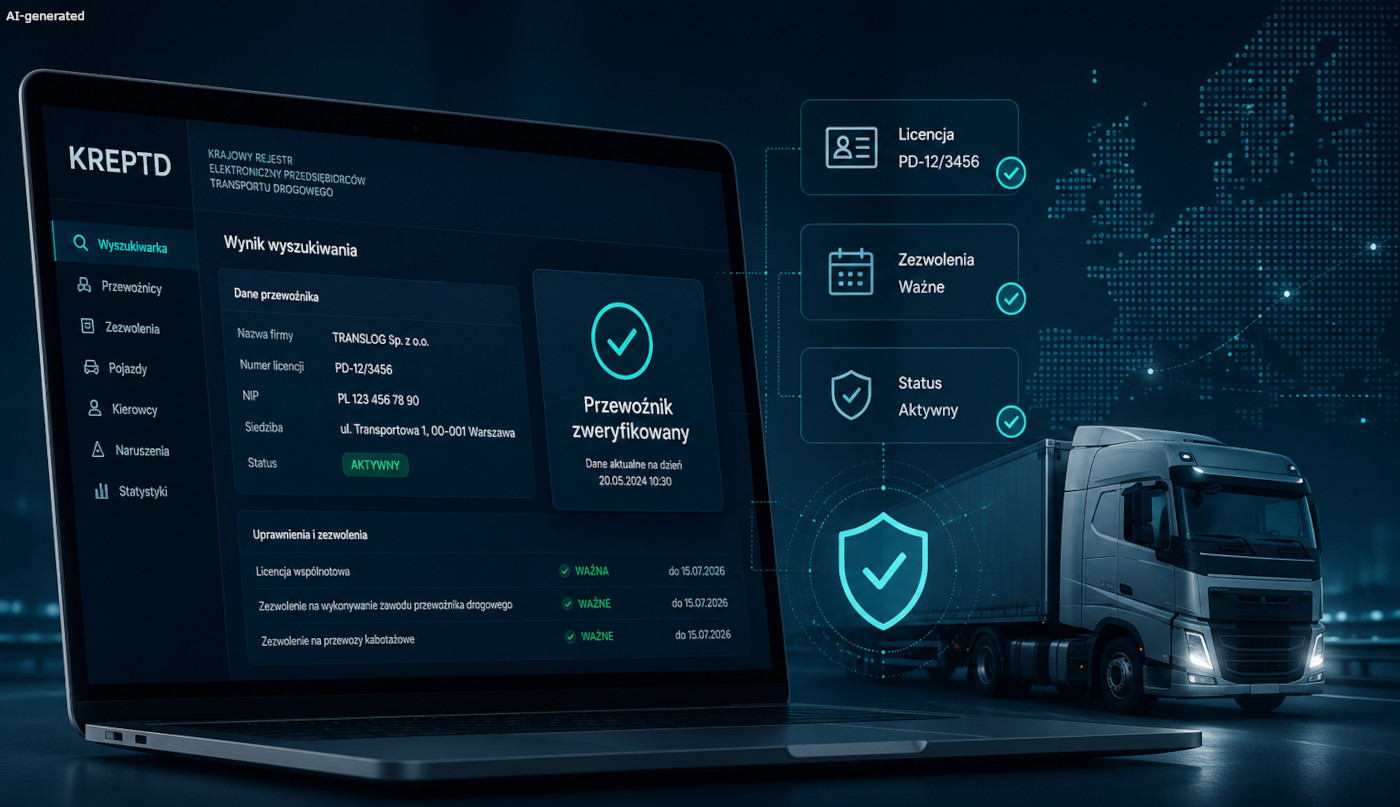

Under applicable law, carrying out road freight transport activities requires the appropriate authorisations. Under the Polish Road Transport Act, this may include, among other things:
The Act also imposes specific obligations and restrictions, such as the prohibition on holding more certified copies than permitted under Article 11a of the Act, as well as the obligation to notify changes in registered details under Article 14.
It’s fair to say that the days when verification of a carrier’s authorisations could be limited either to checking that the carrier was registered on a freight exchange – because, after all, “the exchange must have checked them” – or simply obtaining a scan of a permit or licence are long gone.
The KREPTD register, maintained by the Polish Chief Inspectorate of Road Transport (GITD), makes it possible to carry out a relatively detailed verification of a potential counterparty in terms of the authorisations required by law to provide road transport services.
The register allows searches using, among other things, the company’s NIP tax identification number, the KREPTD reference number, the company name, the permit number, the licence number.
Once a specific company has been found in the KREPTD database, the search result is divided into several sections: “Basic Information”, “Transport Managers”, “Certified Copies of the Authorisation”, “Certified Copies of the Licence”, “Legal Representatives”.
This section should contain details of the transport manager or the natural person referred to in Article 7c of the Polish Road Transport Act.
It is advisable to check whether the carrier has at least one person registered as:
This section contains information on the number of certified copies of the authorisation issued by the competent authority at the carrier’s request.
It is advisable to check:
It is worth remembering that:
This section contains information on the number of certified copies of the Community licence issued by the competent authority at the carrier’s request.
It is advisable to check:
As with the authorisation, the original licence may be carried in one of the vehicles. It is therefore acceptable for the number of certified copies to be one lower than the number of vehicles registered under the licence.
This section contains information on any legal representatives appointed by the company.
There is no general requirement for a carrier to have such a representative, so if the register displays “Items found: 0”, this should not in itself be treated as a cause for concern.
In practice, the vast majority of carriers do not have a legal representative listed, and this section is therefore often empty.
“Where an undertaking does not satisfy the requirement of professional competence laid down in Article 3(1)(d), the competent authority may authorise it to pursue the occupation of road transport operator without a transport manager designated in accordance with paragraph 1 of this Article, provided that:
(a) the undertaking designates a natural person residing in the Community who satisfies the requirements laid down in Article 3(1)(b) and (d), and who is entitled under contract to carry out the duties of transport manager on behalf of the undertaking;
(…)
(c) in his capacity as transport manager, the person referred to in point (a) may manage the transport activities of up to four different undertakings carried out with a combined maximum total fleet of 50 vehicles. Member States may decide to lower the number of undertakings and/or the total size of the fleet which that person may manage;
(…).”
Article 4(2)(c) therefore makes it clear that in the case of the so-called “lending” of Certificates of Professional Competence, the person making their certificate available:
Article 11a of the Polish Road Transport Act provides that an undertaking holding an authorisation to pursue the occupation of road transport operator or a Community licence is prohibited, among other things, from using vehicles for domestic or international road transport that have not been notified to the authority issuing the authorisation.
Furthermore, Article 11 of the Act of 26 January 2022 amending the Road Transport Act, the Drivers’ Working Time Act and certain other acts provides that where a road carrier had registered a vehicle under a Community licence before the amendment entered into force, but had not registered that vehicle under the authorisation to pursue the occupation of road transport operator, the carrier was required to notify that vehicle under the authorisation within three months of the amendment entering into force.
As with many other verification methods, the ability to use the information available in KREPTD properly – and to analyse it carefully – can significantly reduce the risk faced by the party commissioning the transport.
Author: Kamil Krasuski
Verifying a road carrier can be time-consuming.
If you do not want to spend your own time and resources analysing KREPTD data manually, you can use the automated verification process available in the BtrustUP application.
Contact us:
[email protected]
+48 327 298 000