Carrier verification 19.09.2025
Examples of Documents Worth Requesting from a Counterparty
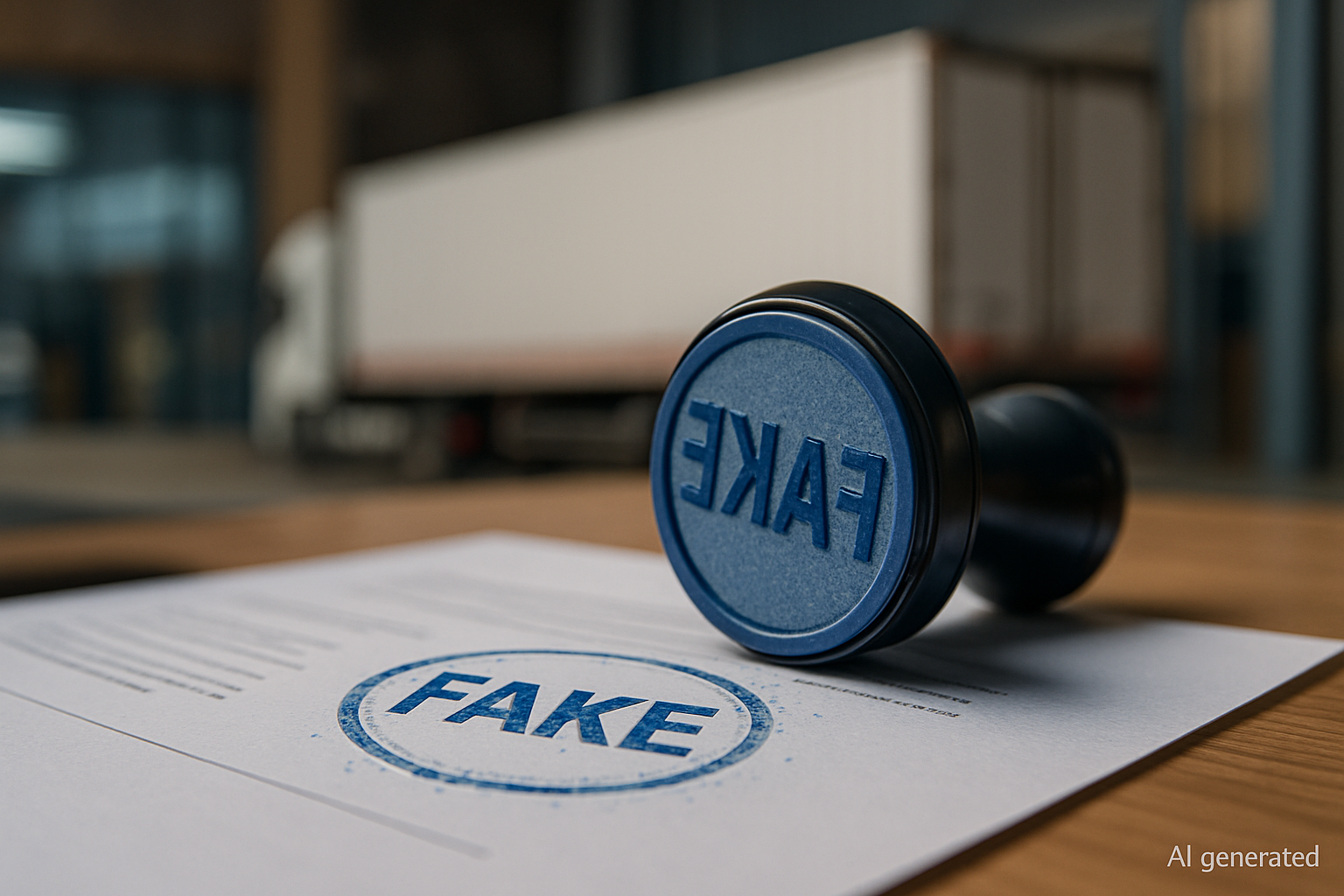

The cult Polish comedy Teddy Bear (Miś) tells the story of Ryszard Ochódzki, who attempts to travel to London using Stanisław Paluch’s passport. The film is, of course, a comedy and still provides plenty of amusement, even to younger viewers born well after Poland’s political transformation.
In real life, however – particularly in the TSL industry – the unauthorised use of another person’s, and more commonly another company’s, documents has quite the opposite effect. Instead of amusement, it often leads to financial loss, fear and a considerable amount of stress.
One of our previous articles, (“Verification of Contact Details Email Addresses and Phone Numbers)”, focused on checking whether we are genuinely communicating with the person or company whose details appear in an email signature or on a freight exchange profile.
To use the Teddy Bear analogy: how can we establish that the person presenting the passport is actually Ryszard Ochódzki rather than Stanisław Paluch?
Once contact details have been verified and found to be consistent, the next step before entering into cooperation may be to obtain the prospective counterparty’s so-called “company documents.”
Over the years, document forgery has become less common, largely because fraudsters rarely need to alter documents they have managed to obtain.
Nevertheless, document forgery still occurs, which is why verifying a counterparty’s documents remains a sensible precaution.
The term “company documents” generally refers to documents confirming that a business is legally operating and holds the licences or permits required by law. In the TSL industry, this set of documents also very often includes a copy or scan of the carrier’s liability insurance policy.
Typically, counterparties are required to provide:
As a general rule, there is no formal definition specifying exactly which documents should be treated as “company documents” and obtained from a counterparty before cooperation begins.
The list of required documents usually results from:
and/or
In addition to the documents listed above, which may be regarded as a reasonable minimum, counterparties may also be asked to provide additional documents, such as:
and many others.
Given the need to act quickly and the limited time available to freight forwarders, a practical solution may be to create a shorter list of documents that should be sufficient for a thorough initial verification of the counterparty.
If verification of these documents – or the information available in official registers – proves insufficient, it may then be reasonable to request additional documents and/or information in order to resolve any outstanding concerns.
When providing cover for losses resulting from fraud, insurers impose a number of obligations in their insurance terms and conditions. These requirements are becoming increasingly detailed year by year. The number of obligations is also growing, while the sublimits applicable to fraud-related losses are often being reduced.
Insurers’ requirements most commonly specify:
In this article, we will focus on the first of these points, i.e. examples of the documents insurers require their policyholders to obtain from counterparties.
TUiR “WARTA” S.A., in §14(6)(1) and (3) of its General Terms and Conditions for Transport Operator Liability Insurance covering road carriers and freight forwarders, requires the insured party to obtain readable copies of documents forming the basis of the company’s business operations, including business registration records or KRS extracts, NIP and REGON details, as well as the relevant permits or licences required by law for transport or forwarding operations.
The insured party is also required to obtain documents confirming that the counterparty holds appropriate carrier’s or freight forwarder’s liability insurance.
UNIQA Towarzystwo Ubezpieczeń S.A., which introduced a separate clause for this type of risk entitled “Release of a Shipment to an Unauthorised Person,” also requires the insured party to obtain readable copies of documents confirming the basis of the company’s operations, including business registration or KRS records, NIP, REGON, an international road transport licence, and the carrier’s liability insurance policy.
STU Ergo Hestia S.A., in special terms offered to one of my clients, required readable copies of documents:
Another of my clients received an insurance offer from Compensa Towarzystwo Ubezpieczeń S.A. Vienna Insurance Group. Under the proposed terms, the policyholder would be required to request and verify licences, permits or concessions held by subcontractors to the extent necessary for the transport activities entrusted to them.
The subcontractors would also need to hold valid road carrier’s liability insurance throughout the entire transport operation. For subcontractors established outside Poland, the insurer required either a policy issued in Polish or a policy certificate available in English. The insurance would have to provide full cover, including theft and robbery risks, cover the relevant type of cargo, and provide an adequate sum insured.
Although insurers are imposing an increasing number of verification requirements, for example regarding checks in the KRS or KREPTD registers, their requirements concerning the actual documents that must be obtained from counterparties still appear to remain at a reasonable and manageable level.
Ideally, the documents should be sent directly by the counterparty as attachments to an email. Obtaining the documents independently from the carrier’s profile — for example, downloading them from a freight exchange or from the company’s website — is not the best approach. In certain situations, this may prevent you from detecting that the person you are communicating with is impersonating an existing company.
Always request clear and readable scans or photographs so that the documents can be properly inspected visually.
When fraudsters alter a document, it sometimes happens that the forged document is sent in noticeably poorer quality than the other documents. This may be intended to make it more difficult to spot inconsistencies, such as the use of a different font, differences in the background, or other signs of manipulation.
Once the documents have been obtained, they should be checked carefully. At a minimum, the verification should include:
A thorough review of the documents should help identify potential forgery.
However, the fact that a document is genuine does not mean that the person requesting the transport order is not a fraudster.
Document verification, just like verification of contact details, should therefore be treated as only one of several verification measures that should be carried out before entrusting a shipment to a carrier.
Fraud methods in the Transport&Logistics industry are constantly evolving, which means that verifying a carrier only once — or relying on documents, freight exchange profiles and basic checks — may no longer be enough.
BtrustUP helps freight forwarders, carriers and logistics companies verify business partners more thoroughly, identify potential warning signs and make safer decisions before entrusting cargo to a counterparty. The platform brings together key verification data and automates time-consuming checks, helping your team reduce operational risk without slowing down day-to-day business.
Verify smarter. Reduce risk. Protect your cargo. Try BtrustUP free of charge and see how automated carrier verification can support your business.